
01

Drop
You finish your drink at the corner. Instead of throwing it in the basket, you drop it into the mouth of a tube.
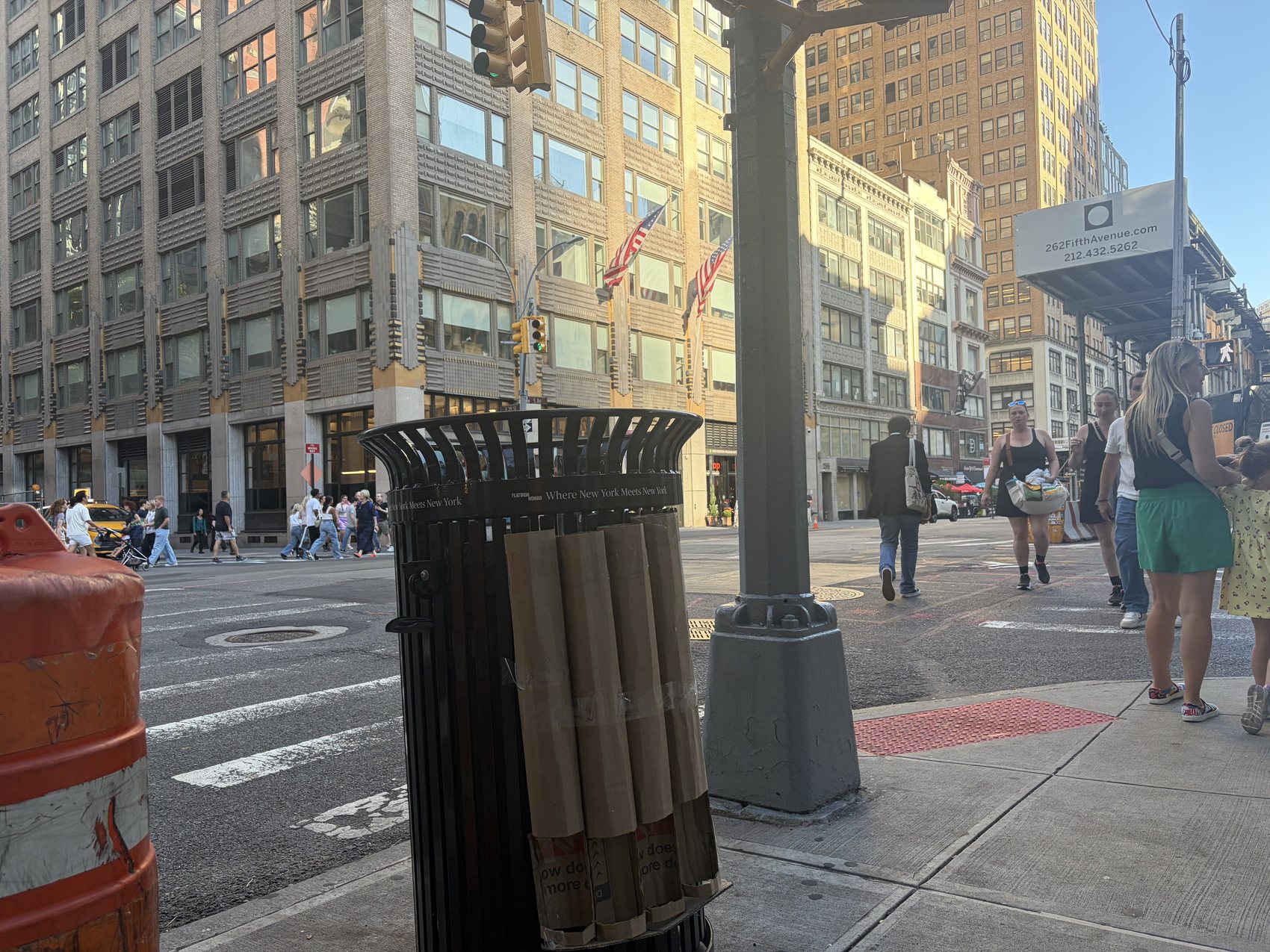
Drop Empties builds the Deposit Rack. It is a tube that straps to a city litter basket. You drop your can in the top. Someone who needs it takes it from the bottom.
01 The problem
Every day in New York, people called canners walk the same blocks you do. They collect bottles and cans for the deposit refund. Most of that work happens at the litter basket on the corner. The containers are in there, under the coffee cups and at the bottom of somebody's takeout bag.
The city already put a bin on almost every corner. It just never gave anyone a place to leave a can where the next person could pick it up without reaching in after it.
At first this might seem like a policy problem. However, it is a design problem first. Germany built a version of the answer and called it the Pfandring. It is a steel ring bolted to a public bin so bottles can be set down instead of thrown away. New York has nothing like it.
Because of this, the Deposit Rack is shaped for what actually gets thrown out here. It takes the 12 oz can and the 1 litre bottle, and it straps on instead of getting bolted down.
02 The object
Four anodised aluminium tubes chained by a single rail that straps to the outside of a standard city basket. You load it from the top and take from the bottom.

The rail carries one Ø92 mm slot over each tube. It passes a can and a bottle. It turns away the coffee cup, the pizza box and the bag.
Two flexible stainless bands wrap the existing bin. Nothing is drilled, welded or bolted into city property. Because of this, a pilot can be approved in a conversation instead of a two-year purchase.


03 How it works
You finish your drink at the corner. Instead of throwing it in the basket, you drop it into the mouth of a tube.

The can falls the length of the tube and lands on the two floor bars. The next one stacks on top of it. Four tubes hold about twenty containers, upright, dry, and out of the trash stream.

Whoever comes for them reaches into a window at the bottom, takes the lowest can, and the column drops one place.

04 Field test


05 Why now
The Bigger Better Bottle Bill would expand New York's deposit system. It would cover far more of what people actually drink and raise what each container returns. If it passes, the number of containers worth collecting goes up sharply. However, every one of them still has to come out of a trash basket by hand.
Drop Empties is not waiting for that. The Deposit Rack works under the system we have now, and it works better under the one we are asking for.
06 What's next
Ten Deposit Racks built in clear anodised 6061 aluminium, each with the hemmed take-out window, the sight slot and the powder-coated rail.
Place them on a single block with a willing partner, like a BID, a bodega or a community board. All ten sit in one walkable stretch. This means the people who collect can build a route around them.
07 Who's building it

I am a high school student in New York who became interested in canners after seeing how much work goes into something most people walk past. I started noticing canners on my own block, digging through trash and sorting cans in the heat.
As an Asian American, I have also seen people from my own community doing this work, often without much recognition. The more I noticed them, the more I wanted to understand their lives and the system around them. My goal for building the Deposit Rack is to make canning a little safer, easier, and more respected.